Hammerblaze: What Thunderkick Adds to Cluster Slots in 2026
Hammerblaze is Thunderkick’s fire-themed online slot released on 27 May 2026, and its main idea is easy to understand: wins should create movement rather than end a spin immediately. The game uses a 7×7 grid, Cluster Pays, falling symbols, Exploding Wilds and a multiplier layer that becomes especially important in the bonus round. This combination gives the release a noticeably different rhythm from a conventional five-reel slot, yet the rules remain readable after a few rounds. The central question is not simply how many features Hammerblaze contains, but how well they work together. Thunderkick has built the game around one continuous sequence in which clusters disappear, new symbols fall, Wilds break sections of the grid and multiplier positions can improve later wins. That makes Hammerblaze a useful example of how a modern slot can add depth without turning every spin into a long set of complicated instructions.
Hammerblaze Brings a Larger Grid and Faster Chain Reactions
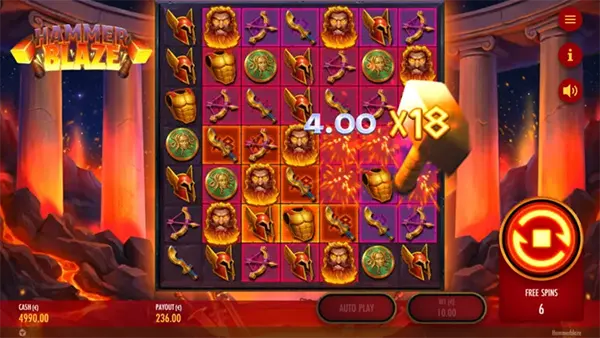
The first major change is the 7×7 playing area. Instead of fixed paylines running from left to right, Hammerblaze pays for groups of at least five matching symbols connected horizontally or vertically. A larger grid gives matching symbols more room to meet, but it does not mean that every spin produces a meaningful return. The layout mainly supports the game’s chain-reaction design: once a cluster wins, those symbols are removed and replacements fall into the empty spaces. One paid spin can therefore contain several separate results, each created by the symbols left behind after the previous win. This format is familiar to regular cluster-slot players, but Thunderkick uses it as the base for a more specific idea. The grid is not only a place where combinations form; it is also a surface that can be cleared, marked with multipliers and changed by Wild explosions.
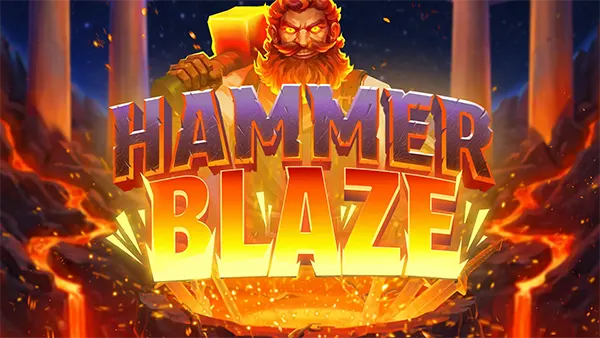
Hammerblaze’s theme supports that structure rather than sitting apart from it. The action takes place in a volcanic forge inspired by Hephaestus, the Greek god associated with fire and metalworking. Armour, weapons, flames and heavy hammer strikes give each removal or explosion a clear visual purpose. This matters on a busy 49-position grid, where weak visual separation can make wins difficult to follow. Thunderkick keeps the symbols distinct and uses impact animations to show which part of the field has changed. The presentation is energetic, but the important information remains visible: winning clusters disappear, new symbols fall from above and multiplier positions stay marked when active. As a result, players can usually understand why a sequence continues without needing to study a dense paytable during every round.
The pace is another notable part of the release. Cluster games can feel slow when each cascade is separated by long animations, yet Hammerblaze moves quickly between a winning group, its removal and the next symbol drop. The result is a compact cycle that can produce several events from one stake. That speed does not change the mathematical risk, but it changes how the session feels. A single round may end at once, while another may continue through repeated falls, Wild activity and multiplier use. Thunderkick’s new contribution is therefore less about inventing one isolated feature and more about linking familiar features so that each one creates a reason for the next. The game feels most distinctive when a basic cluster develops into an Avalanche, then into a Wild explosion and finally into a multiplied follow-up win.
How Cluster Pays and Avalanches Shape Each Spin
A winning cluster begins with five or more matching symbols touching along their sides. Diagonal contact alone does not join a group, so the position of each symbol matters. Larger connected groups generally produce higher payments than the minimum five-symbol cluster, which makes the wide field useful when several matching icons gather in the same area. Once a win is counted, all symbols in that cluster leave the grid. Symbols above them then drop down, and new icons enter from the top. Thunderkick calls this continuing fall an Avalanche. The process repeats for as long as a new winning cluster appears. Players therefore receive one combined sequence rather than paying again for every symbol refill, although the total return still depends entirely on the game’s random result and paytable.
The Avalanche system also helps weaker-looking starting grids become more interesting. A first win may be small, but removing its symbols changes the shape of the field and can bring matching icons together in places that were previously separated. This is why Hammerblaze should not be judged only by the first visible cluster. The important moment often comes after one or two removals, when the grid has been rearranged and a Wild or multiplier position becomes involved. At the same time, many paid spins will stop after the initial layout or after one modest win. The design creates the possibility of momentum, not a guarantee of it. That distinction is important in a very high-volatility game, where entertaining chains can be separated by rounds that return little or nothing.
From a usability point of view, the system is simpler than its 7×7 appearance suggests. There are no payline patterns to memorise and no requirement for a cluster to begin on a particular reel. Players mainly need to watch for connected matching symbols, then follow the spaces created when they disappear. The game automatically calculates every valid group, so the player’s only decision in the standard base game is the stake. This keeps Hammerblaze accessible to people who understand ordinary slots but have limited experience with grid games. The deeper element comes later, when Exploding Wilds begin to leave multiplier values behind. By introducing the rules in layers, Thunderkick lets the basic cluster and Avalanche cycle remain clear before the more valuable grid effects start to matter.
Exploding Wilds Turn Empty Spaces into Multiplier Positions
Exploding Wilds are the feature that gives Hammerblaze its own identity. A Wild can substitute for regular paying symbols and help complete a cluster, but its role does not necessarily end when the ordinary wins have been counted. When the sequence reaches the relevant stage, an Exploding Wild can clear a 3×3 area around its position. The blast removes nearby symbols and creates more empty spaces for the Avalanche process, so one Wild can change several parts of the field at once. This is useful because the explosion may remove symbols that were not part of the original winning cluster, allowing a much larger refill than a standard cascade would create. The visual hammer strike makes the event obvious, while the mechanical effect is straightforward: more cleared positions mean more new symbols and another chance for connected groups to form.
The more important result of an explosion is the Multiplier Grid Feature. Cleared positions can receive multiplier values that apply when later winning symbols occupy those spaces. In the standard rule set, a fresh affected position begins at 2×, and repeated overlapping explosions can increase the value, with individual positions able to rise as high as 128×. This creates a second layer beneath the visible symbols. A location that looks ordinary at the start of a spin can become far more valuable after a Wild blast. The multipliers do not make a win appear by themselves; a valid cluster still has to form across the relevant positions. Their purpose is to strengthen a qualifying win when its symbols land on marked cells. That balance keeps the feature understandable: the grid can become valuable, but it still needs the right symbols.
Overlapping explosions are where the mechanism becomes most interesting. If a new 3×3 blast covers a position that already carries a multiplier, that position can improve instead of simply being marked again at the starting value. Several nearby Wilds may therefore build a concentrated area with stronger multipliers. The player is not choosing where those Wilds land, so there is no strategy for directing the grid. The appeal comes from watching a promising section develop and then seeing whether later clusters use it. In the base game, multiplier progress is tied to the current paid-spin sequence and does not become a permanent advantage for future stakes. This prevents the game from turning into a long-term collection system, while still allowing one extended chain to grow from a normal cluster into a much larger result.
Why the Bonus Game Changes the Value of the Grid
The bonus round changes the Multiplier Grid from a short-lived feature into the main event. In the standard version, three Scatter symbols award ten free spins. Multiplier positions created during the bonus remain in place for the rest of that feature, so an early Wild explosion can affect several later spins rather than only one Avalanche sequence. This persistence is the key difference between ordinary play and free spins. The visible symbols still reset for each round, but marked cells underneath them remain available and can be strengthened by further overlapping blasts. As the bonus continues, the grid may contain several separate multiplier areas or one concentrated section with higher values. The round becomes easier to follow because the player can see a clear form of progress, even though the next symbols and final return remain random.
Retriggers can extend that process. Landing the required Scatter combination during free spins awards additional rounds under the same sticky-grid conditions, giving established multiplier positions more chances to be used or upgraded. This does not mean a longer bonus will automatically pay well. A strong multiplier may sit in an area that later clusters fail to cover, while a modest multiplier can become useful if a large group lands across it. Hammerblaze therefore creates tension through position as much as through value. The player is not simply waiting for a large number to appear; the winning symbols also need to connect through the right cells. That relationship between the upper symbol grid and the multiplier layer is the most important feature in the release and the clearest answer to what Thunderkick has added to the familiar cluster format.
Some versions also include paid access or enhanced-bet settings, subject to local rules and the operator’s configuration. Common options described for Hammerblaze include a feature purchase priced at about 100 times the selected stake, plus Bet+ modes that raise the cost of each spin in exchange for a higher chance of entering the bonus. These controls do not improve a player’s certainty of profit and should not be treated as shortcuts to the 10,000× maximum. A purchased feature can return less than its price, while repeated higher-cost spins can use a budget quickly. Availability may also differ between countries. Before using any optional mode, players should read the information panel in the exact version they are playing, confirm the total stake shown on screen and decide on a fixed limit rather than increasing spending after an unsuccessful bonus.
What the Numbers Say About Risk, Return and Practical Play
Thunderkick lists Hammerblaze with an RTP of 94.13%, very high volatility and maximum exposure of 10,000× the stake. These figures describe three different aspects of the game. RTP is a theoretical long-term return calculated across a very large number of rounds; it does not predict the result of one session. At 94.13%, the mathematical house advantage in the listed version is 5.87%, but individual play can finish far above or below that theoretical line. Very high volatility means returns are expected to be uneven, with many low-value or losing spins balanced mathematically by less frequent larger wins. The 10,000× figure is the game’s upper payment limit, not a typical target. It should be viewed as a cap built into the rules rather than an outcome a player can reasonably expect during ordinary play.
Those numbers make stake selection more important than the fiery presentation. A 7×7 grid can create busy rounds and repeated Avalanches, but frequent movement should not be confused with frequent profit. Some cascades may consist of several small payments that still fail to cover the original stake. Very high volatility can also produce long periods without a bonus or a substantial cluster. A sensible approach is to choose a stake that allows enough rounds to assess the game without creating pressure to chase a result. For example, dividing a fixed entertainment budget into at least 100 standard spins gives more control than using a large stake for a handful of rounds. This does not improve the odds, but it reduces the risk that a short losing sequence immediately ends the session or encourages an unplanned deposit.
Players should also confirm the technical information inside the game before staking money. The 94.13% figure is the configuration published by Thunderkick, but the information screen remains the correct place to check the version actually supplied by an online casino. The same screen should show stake limits, feature availability, paytable values and any rules that apply to optional bonus access. Mobile play should be tested in demo mode where available, especially on smaller screens, because the 49-position grid contains more visual information than a standard reel set. Hammerblaze is designed to keep the important events visible, yet a player should still be able to read the current stake, total win and multiplier markings comfortably. Clear information is more valuable than fast animation when real money is involved.
Who Hammerblaze Is Best Suited To in 2026
Hammerblaze is most likely to suit players who already enjoy Cluster Pays, cascading wins and bonuses that build a visible state over several spins. Its strongest quality is coherence: the forge setting, hammer impacts, Wild explosions, cleared cells and multiplier grid all support the same basic idea. The features are connected rather than presented as unrelated interruptions. Players who prefer classic three-reel games, fixed paylines or frequent low-variance returns may find the 7×7 field and very high volatility less comfortable. The base game can move quickly, but it can also produce quiet stretches. A demo session is therefore useful for checking the pace and readability before real-money play. The aim should be to understand the game’s rhythm, not to estimate future results from a small sample of free rounds.
For Thunderkick, the release shows a practical way to develop a familiar category without relying on an excessive number of separate bonuses. The studio combines a large cluster grid with its established interest in Avalanches, Wild behaviour and persistent multipliers, then gives each element a clear job. Cluster wins create space, falling symbols refill it, Exploding Wilds clear wider areas and the multiplier layer gives later clusters a reason to matter more. The bonus round extends this logic by keeping multiplier positions active. None of these ideas is difficult on its own, which helps the finished game remain approachable. The novelty comes from timing and interaction: one ordinary-looking win can alter the grid enough to start a sequence that becomes much more valuable several steps later.
Hammerblaze should still be assessed as a very high-volatility gambling product rather than a progression game in which patience guarantees a reward. Its maximum win, sticky multipliers and feature access can make the upper potential look prominent, but every outcome is produced by the certified random game logic. Previous losses do not make a bonus more likely, and a strong demo result says nothing about the next paid session. Adults who choose to play should use money set aside for entertainment, avoid borrowing, set time and spending limits, and stop when the planned budget is gone. Seen on those terms, Hammerblaze is a well-organised 2026 release with a clear mechanical identity: Thunderkick takes the familiar cluster format and gives it a more focused relationship between explosions, position-based multipliers and persistent bonus progress.