
Wheel of Mictlan: How the Wheel Mechanic Works in an Aztec Mythology Slot
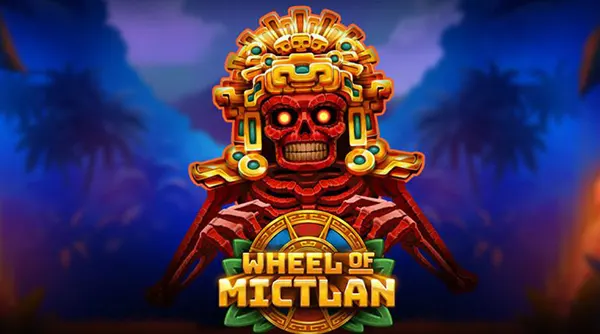
Released by Play’n GO on 19 March 2026, Wheel of Mictlan is a five-reel video slot built around a large stone wheel, an underworld setting and the figure of Mictlantecuhtli. The game takes its name from Mictlan, the realm of the dead in Aztec belief, but it treats the mythology as a stylised setting rather than a historical reconstruction. Its central idea is easy to follow: standard reel play provides the basic structure, while Bonus symbols can shift attention to the Wheel of Mictlan, where a separate random result may add a multiplier, an instant prize, Free Spins or access to a Cashpot round. This makes the wheel more than a decorative object. It is the main point at which the theme and the game’s additional features meet.
The Wheel as the Main Link Between Theme and Mechanics
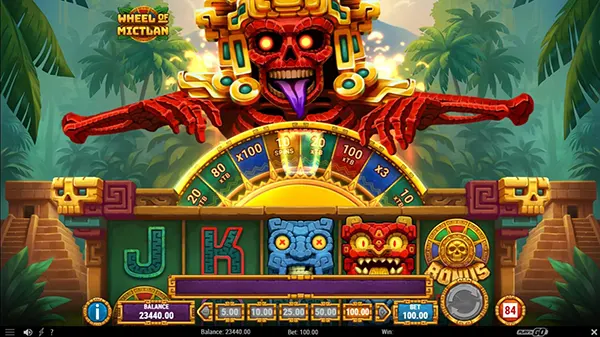
Wheel of Mictlan uses a 5×3 reel layout with 10 fixed paylines, so the underlying game is deliberately conventional. Matching symbols form wins across the lines, while Wild, Scatter and Bonus symbols provide the routes into the additional features. That relatively simple reel structure matters because the wheel already introduces a second stage of uncertainty. The player does not have to follow several meters or collection systems at the same time. Instead, the reels establish whether a normal win or a special trigger has appeared, and the wheel becomes relevant only when the required Bonus conditions are met.
The Bonus symbol has two jobs. It can substitute for ordinary paying symbols, and every Bonus symbol that lands has a chance to activate the Bonus Wheel. Landing three Bonus symbols guarantees that the wheel is triggered. This distinction is important because the wheel is not tied only to a rare three-symbol combination: a smaller number of Bonus symbols can still lead to it, although no activation is assured. The result is a mechanic that can interrupt otherwise normal reel play without being present on every spin. When it does appear, the wheel selects one of four different prize categories rather than repeating a single fixed reward.
That design gives the wheel a clear role in the pacing of the game. A spin can first produce ordinary line results and then move into the wheel sequence if the Bonus condition is met. The wheel therefore acts as a bridge between the base game and several other features. It can modify a win that has already formed, award a separate amount, extend play with Free Spins or move to another screen for the Cashpot feature. This is why the title refers to the wheel rather than to a single bonus round: it functions as a routing device that determines which type of additional result follows.
What the Four Wheel Outcomes Actually Do
The first possible wheel result is a multiplier. Published game information lists multiplier values of x2, x3, x5, x10, x20, x25, x50 and x100. When this result is selected, the multiplier is applied to reel wins from the triggering spin. The practical point is that the wheel does not create a separate symbol combination in this case; it changes the value of an existing reel result. A high multiplier therefore matters most when the triggering spin has already produced a meaningful win. A large multiplier on a small line win can still produce a modest final amount, so the number shown on the wheel should not be read as a guaranteed large payout.
The second and third outcomes work differently. An Instant Prize is paid directly as a multiple of the triggering bet, with published values ranging from 8x to 200x. The Free Spins outcome awards 5, 10, 15 or 20 spins. If the wheel awards Free Spins while a Free Spins round is already active, those spins are added to the remaining total rather than starting a completely separate feature. This creates a useful distinction between the wheel outcomes: multipliers depend on the reel win they modify, instant prizes are fixed relative to the stake, and Free Spins provide additional opportunities for the slot’s existing mechanics to appear again.
The fourth outcome is Cashpot, which moves play to a Match 3 mini-game. The screen presents covered skulls, and selections continue until three matching Cashpot tiers are revealed. Current published rules list three fixed levels: 1,000x, 2,500x and 5,000x the triggering bet. The choice of skull does not turn the feature into a skill game; it is still governed by the game’s random result. From a design perspective, Cashpot gives the wheel its most distinct branch because it changes the presentation and interaction for a short period, while the multiplier, instant-prize and Free Spins outcomes remain more closely connected to the normal reel cycle.
How Wild Flip and Free Spins Change the Role of the Wheel
The wheel is only one part of Wheel of Mictlan’s feature structure. The other important mechanic is Wild Flip. In the base game, two or more Flip Wilds activate the feature, and each qualifying Wild has a chance to expand vertically into a full-reel Wild. Published game-rule summaries specify a 50% expansion chance for each Flip Wild once the feature has been activated. A full Wild reel can help complete several paylines at once, but the expansion itself is not guaranteed. This two-step sequence — first landing enough Wilds, then seeing whether they expand — adds variation without changing the familiar five-reel format.
Three Scatter symbols award 10 Free Spins, and the same Scatter requirement can add another 10 during the feature. Free Spins also make Wild Flip easier to activate because only one Flip Wild is needed to start the expansion check. The wheel remains available during this round, so Free Spins are not a separate mode that switches the other mechanics off. Published rules allow the total number of Free Spins to build to a maximum of 140 through retriggers and wheel awards. That upper limit describes what the game permits, not what a player should expect to receive in a typical bonus round.
The relationship between Free Spins and the wheel is one of the most important parts of the design. A wheel result can award more Free Spins, while those spins create more chances for Bonus symbols and easier Wild Flip triggers to appear. This can produce sequences in which one feature extends the opportunity for another feature to occur. It is still incorrect to treat this as a progression system that becomes more favourable over time. Each eligible event is determined by the game rules and random outcomes. A long Free Spins round creates more spins, but it does not guarantee a high multiplier, a Cashpot result or a large final return.
Why the Wheel Feels Central Without Controlling Every Spin
Although the wheel is the visual centrepiece, most spins are still resolved on the reels. Line wins, Wild substitutions and Scatter appearances do not require the wheel to function. The Bonus Wheel is an additional event that can be triggered by Bonus symbols, which means its importance comes from the range of outcomes it controls rather than from constant activity. This distinction keeps the game understandable: the player can read the reel result first and then follow the wheel only when it is activated. The design avoids making every normal spin depend on a separate wheel animation.
Mictlantecuhtli is used heavily in the presentation of the wheel, but his changing size on screen does not alter the mathematics of a spin. Play’n GO states that Bonus symbols can make the character grow during the Bonus Wheel sequence and that he returns to normal afterwards, but this is a visual effect only. It does not increase the probability of a multiplier, change the Cashpot tier or make a future wheel trigger more likely. That detail is worth stating because animated characters in feature-heavy slots can sometimes look like progress indicators even when they have no mechanical function.
The same principle applies to the wheel itself. There is no player decision that can force it towards a preferred segment, and previous outcomes do not make a particular prize due on the next activation. The useful information is therefore found in the game rules: what can trigger the wheel, which four result types are available and how each result is calculated. Reading those rules gives a clearer picture than trying to infer patterns from a short session. The wheel adds variation and presentation, but it does not provide a method for predicting or controlling the next result.
Aztec Underworld Theme: Where the Wheel Fits the Story
Play’n GO presents Wheel of Mictlan as an underworld story set among jungle ruins, carved stone, masks and watchful guardians. Mictlantecuhtli, associated with death and Mictlan in Aztec belief, is placed above the reels as the dominant character. The developer describes the temple itself as part of the storytelling rather than a passive background, and the large stone wheel is used as the recurring visual object that links the scene to the bonus mechanics. Warm greens, aged gold, stone textures and animated statues keep the setting readable without turning the reel area into a dense historical illustration.
The wheel should be understood as a creative game device, not as evidence that Aztec religious practice used a prize wheel of this kind. Its purpose is symbolic and mechanical: the circular stone object suggests ritual, fate and repetition, while also giving the game a clear way to display several possible bonus results. That approach allows the theme to support the rules without requiring detailed knowledge of Aztec religion from the player. The name Mictlan and the presence of Mictlantecuhtli provide the strongest mythological references; the rest of the visual treatment uses broad Mesoamerican-inspired fantasy to create atmosphere around those recognisable ideas.
This separation between inspiration and historical accuracy is useful when assessing the theme. Wheel of Mictlan is an entertainment product, so its symbols, animation and sound are arranged to make features easy to recognise and to give the wheel a strong visual identity. The mythology supplies names, imagery and mood, while the actual bonus structure follows modern slot conventions such as expanding Wilds, Free Spins, multipliers and fixed Cashpot prizes. The theme and mechanics are therefore connected, but they are not the same thing: the setting explains why the wheel looks ceremonial, while the game rules explain what happens after it stops.
What Players Should Check Before Using a Real-Money Version
One specification deserves particular attention: RTP can vary between versions of Wheel of Mictlan. Industry listings published in 2026 do not show one universal figure. iGaming Business lists theoretical configurations from 84% to 96%, while other game-rule databases show a default version around 96.2% together with lower alternatives. This means the RTP displayed by one casino should not automatically be assumed to apply elsewhere. Before using a real-money version, the sensible step is to read the information or paytable inside that specific game and confirm the RTP that is actually active.
Volatility is generally described as medium-high or high, depending on the source and local configuration, and the published maximum win is 40,000x the bet. These two facts should not be confused with an expected session result. The maximum is a ceiling permitted by the game rules, not a target that regular play is likely to reach, while volatility describes how unevenly returns may be distributed over time. The wheel can create large multipliers and fixed Cashpot prizes, but it can also award smaller outcomes, and many spins may finish without activating it at all.
For real-money play, the most useful approach is to treat every spin as paid entertainment with an uncertain result. Stake ranges can differ between casinos and jurisdictions, so a fixed spending limit should be based on personal affordability rather than on the size of the advertised maximum win. Free Spins, wheel triggers and expanded Wilds do not change the basic fact that outcomes are random and cannot be made more predictable through previous results. Wheel of Mictlan is easiest to understand when its mechanics are separated from its theatrical presentation: the wheel organises several bonus possibilities, while the player’s risk remains determined by the stake, the active game configuration and random outcomes.