
Dork Unit by Hacksaw Gaming: Review of a Chaotic Cartoon Slot with Unusual Mechanics
Dork Unit by Hacksaw Gaming stands out in the modern slot catalogue thanks to its deliberately erratic design and unconventional bonus structure. Released as part of the provider’s experimental line-up, this title blends cartoon-style visuals with mechanics that challenge standard expectations of volatility, payout flow, and feature logic. Instead of predictable patterns, the game leans into controlled randomness, making each session feel structurally different.
Core gameplay mechanics and structure
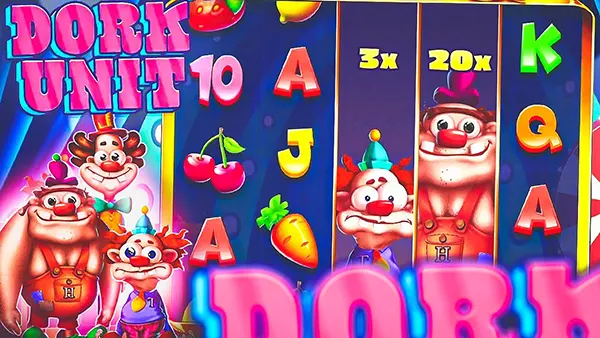
Dork Unit operates on a compact grid format typical for Hacksaw Gaming releases, yet the behaviour of symbols and modifiers makes it far less predictable than traditional video slots. The base game relies on cluster-style wins rather than fixed paylines, meaning combinations are formed by adjacent matching symbols. This already introduces variability, but the real complexity comes from dynamic symbol interactions.
One of the defining features is the presence of modifiers that can alter outcomes mid-spin. These include symbol multipliers, random upgrades, and transformation effects that can trigger without a fixed pattern. Unlike classic slots where bonuses are tied to clear triggers, here they may appear irregularly, creating a sense of instability that is intentional rather than accidental.
Volatility in Dork Unit is firmly on the high side. Long sequences without significant payouts are balanced by occasional sharp spikes when multiple modifiers align. This structure reflects a design choice focused on short bursts of value rather than steady returns, which may not suit every player but is consistent with Hacksaw Gaming’s approach to high-risk formats.
Visual style and thematic execution
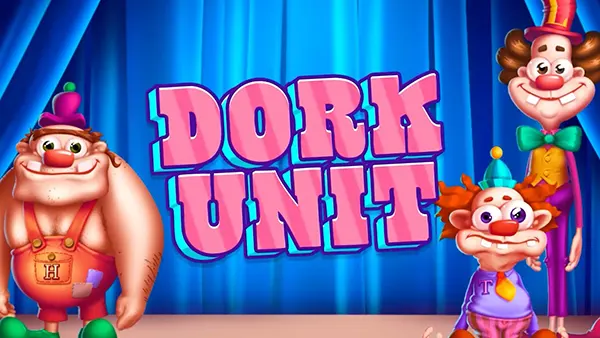
The visual direction of Dork Unit leans heavily into exaggerated cartoon aesthetics. Characters are deliberately distorted, with chaotic animations that reinforce the unpredictable nature of the gameplay. This is not a polished or minimalist design — instead, it embraces visual noise as part of its identity.
Colour palettes are intentionally bold, often contrasting sharply within the same frame. Combined with rapid animation cycles, this creates a sense of constant motion even during standard spins. While some players may find this overwhelming, others will recognise it as a deliberate stylistic choice aligned with the slot’s mechanics.
Sound design follows a similar philosophy. Effects are abrupt, sometimes intentionally mismatched, and designed to mirror the erratic nature of symbol behaviour. Rather than supporting immersion in a traditional sense, audio elements amplify the unpredictability that defines the overall experience.
Bonus features and payout dynamics
The bonus system in Dork Unit avoids conventional structures such as free spins with fixed rules. Instead, it introduces layered features that can interact in unexpected ways. This includes random bonus entries, evolving multipliers, and cascading effects that may or may not extend beyond a single spin cycle.
One notable mechanic is the ability for modifiers to stack. When this occurs, the resulting payout potential increases significantly, but the conditions for triggering such combinations are not transparent. This lack of clarity is intentional and forms part of the game’s risk-reward balance.
Return-to-player (RTP) levels are consistent with Hacksaw Gaming’s typical range, generally around 96%, although exact figures may vary depending on configuration. What matters more in practice is the distribution of wins — most returns are concentrated in rare but high-impact sequences rather than frequent small payouts.
How randomness shapes player experience
Randomness in Dork Unit is not limited to symbol placement. It extends to how features activate, combine, and resolve. This creates a gameplay loop where expectations based on previous spins rarely apply to the next one. As a result, players must approach the slot without relying on pattern recognition.
This design can lead to sessions that feel inconsistent in length and outcome. A short session might produce a significant win if modifiers align early, while longer sessions may result in minimal returns. The variability is a core part of the game rather than a flaw.
For players familiar with traditional slots, this approach requires adjustment. Instead of managing expectations through known mechanics, the focus shifts to understanding volatility and bankroll management in a less predictable environment.
Practical considerations and player suitability
Dork Unit is not designed for players seeking stable or gradual gameplay. Its structure favours those who are comfortable with high variance and irregular reward cycles. This makes it more suitable for short, controlled sessions rather than extended play.
Bankroll management becomes particularly important. Due to the uneven distribution of wins, players may experience prolonged periods without returns. Setting clear limits before starting a session is essential to maintain control over spending.
It is also worth noting that the unconventional design may not appeal to everyone. While some players appreciate the break from predictable formats, others may prefer slots with clearer rules and more consistent pacing. Understanding these differences helps in choosing whether Dork Unit aligns with individual preferences.
Final assessment of gameplay value
Dork Unit reflects a broader trend within Hacksaw Gaming’s portfolio — a willingness to experiment with structure rather than rely on established templates. This results in a slot that feels distinct, though not universally accessible.
The combination of chaotic visuals, unpredictable mechanics, and high volatility creates a specific type of experience that prioritises intensity over stability. For some players, this offers a different perspective compared to standard slot formats.
Ultimately, the value of Dork Unit lies in its originality. It does not attempt to replicate familiar mechanics but instead introduces a system where randomness plays a central role in shaping outcomes, making it a notable example of experimental slot design in 2026.