

Jammin’ Jars 2 by Push Gaming: A Detailed Review of Updated Wilds and Cascades
Jammin’ Jars 2, released by Push Gaming as the sequel to its widely recognised grid slot, remains one of the most technically interesting cluster-based games available in 2026. Built on a 8×8 layout with cascading mechanics and expanding multiplier wilds, it develops the original concept rather than merely repeating it. This review focuses specifically on how the updated wild behaviour and cascade structure affect volatility, payout potential and session management for players who understand modern slot mathematics.
How the 8×8 Grid and Cluster Pays System Define the Core Gameplay
Jammin’ Jars 2 operates on an 8×8 grid without traditional paylines. Wins are formed by clusters of five or more matching symbols that touch horizontally or vertically. This structure immediately changes the rhythm of play compared to line-based slots, as positioning and symbol density become more important than linear alignment.
The cascading mechanic removes winning clusters from the grid and allows new symbols to fall from above. Each cascade within the same spin creates the opportunity for extended combinations, especially when wild jars remain in place between drops. In practical terms, the cascade system increases hit frequency within individual spins rather than across spins.
Push Gaming has retained the high-volatility model from the first instalment. While base game wins can be modest, the grid layout allows significant board control when multiple jars are active. This is not a low-variance title; it is designed for extended sessions where patience is required before volatility translates into meaningful returns.
Mathematics Behind Cascades and Win Amplification
The slot’s RTP typically sits around 96.83% in most licensed configurations as of 2026, though operators may offer reduced RTP versions. The maximum win potential is capped at 10,000x the stake, which places it firmly in the high-volatility category under UKGC and MGA classifications.
Each cascade does not inherently increase multipliers by itself; instead, value growth comes from wild interaction. This distinction is important. Unlike tumbling slots that escalate global multipliers per cascade, Jammin’ Jars 2 relies on jar movement and symbol density to generate large combinations.
The probability distribution is heavily skewed towards medium-to-long drought periods interrupted by cluster expansions. This means bankroll management is critical. Players who approach the game with short-session expectations may misinterpret its statistical design.
Updated Wild Jars: Movement, Multipliers and Strategic Impact
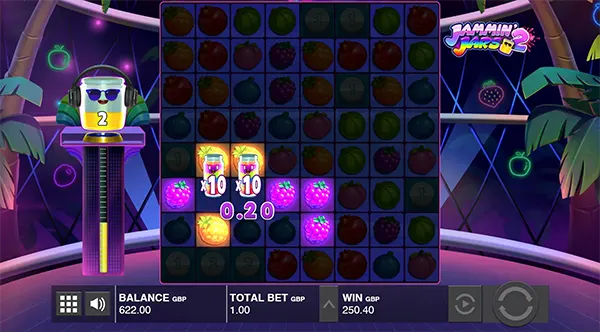
The defining feature of Jammin’ Jars 2 is the animated wild jars. These wilds do not simply substitute for symbols; they move one position after each cascade. This dynamic movement is what differentiates the game from static wild cluster slots.
Each wild jar carries a multiplier that increases by +1 for every cascade it survives within a single spin. If two jars contribute to the same cluster, their multipliers are added together before being applied to the total win. This stacking mechanism is where most significant payouts originate.
The update in the sequel includes improved jar spawning frequency and more consistent mid-spin persistence compared to the original Jammin’ Jars. While not radically redesigned, the balance has been adjusted to create slightly more frequent multi-jar scenarios in both base and bonus rounds.
How Wild Behaviour Changes Risk and Reward Dynamics
When a wild jar lands early in a spin and remains active across several cascades, its multiplier can scale rapidly. For example, a jar surviving four cascades becomes a 4x multiplier before being combined with others. With two jars interacting, combined multipliers of 8x, 10x or more are not uncommon during bonus rounds.
However, jar movement is random within the grid constraints. This introduces positional volatility. A jar may drift away from dense clusters, reducing its immediate impact. The unpredictability is part of the design philosophy: high reward potential balanced by structural uncertainty.
The updated balance in Jammin’ Jars 2 slightly reduces instances where jars exit the grid too quickly. In practice, this leads to longer cascade chains during strong spins, although overall volatility remains high. The adjustment is subtle but noticeable to experienced players familiar with the first game.
Free Spins Mode and Cascade Acceleration in 2026 Context
The bonus round is triggered by landing three bonus symbols, awarding 10 free spins. During this feature, at least one wild jar is guaranteed to be present on the grid at the start of every spin. This structural guarantee significantly increases the average win potential compared to the base game.
Additional bonus symbols during free spins award extra spins, and new jars can enter the grid, allowing multiplier stacking scenarios. The cascading mechanic remains identical, but the guaranteed jar presence shifts the probability curve towards higher-value outcomes.
As of 2026, Jammin’ Jars 2 remains certified under major European regulatory frameworks, including the UK Gambling Commission and Malta Gaming Authority in licensed environments. Feature buy options may be available depending on jurisdiction, but are restricted or disabled in some regulated markets.
Practical Considerations for Session Planning
Because of the 10,000x maximum win cap and high volatility index, bankroll sizing should reflect extended variance. Short sessions may produce limited returns, whereas longer play sessions are statistically more aligned with the game’s design model.
Free spins are the primary source of significant wins. While base game multipliers can produce solid results, sustained multiplier stacking in the bonus feature is where the mathematical model concentrates payout potential.
Jammin’ Jars 2 remains a technically sophisticated example of moving wild mechanics combined with cascading grids. Its updated jar behaviour refines, rather than reinvents, the original concept, preserving its high-risk, high-reward identity while slightly improving consistency of impactful spins.