
Tome of Madness: the strength of set-based gameplay in a Lovecraft-inspired slot
Tome of Madness is a video slot by Play’n GO that stands out not because of surface-level horror aesthetics, but due to its structured gameplay built around a clearly defined symbol set. Inspired by the literary universe of H. P. Lovecraft, the game relies on cohesion between mechanics, volatility, and progression rather than isolated bonus effects. This approach creates a consistent rhythm where each feature supports the overall mathematical model.
Set-based design as the foundation of gameplay balance
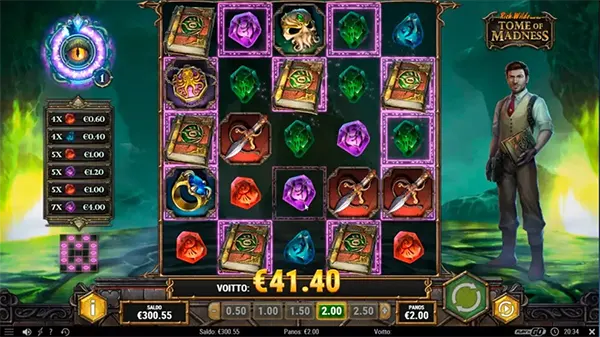
At the core of Tome of Madness lies a symbol system that behaves as a connected framework rather than a collection of independent elements. The four Tome symbols act as a unified set, and their behaviour is predictable in structure while remaining variable in outcome. This allows players to understand how the game evolves without removing uncertainty.
Unlike slots that rely on random bonus triggers with no prior context, Tome of Madness introduces progression through accumulation. Collecting Tomes during base play has a direct impact on the bonus phase, creating continuity between spins. This design choice reduces fragmentation and makes every spin statistically relevant.
From a mathematical perspective, this set-based approach supports medium-to-high volatility while maintaining clarity. The RTP of 96.63% is distributed across base wins and feature interaction, rather than being concentrated in rare, isolated events. This balance appeals to players who value structure over unpredictability.
The role of Tome symbols in structured progression
The Tome symbols are not simple scatter substitutes. Each one represents a specific function within the bonus framework, and collecting duplicates strengthens that function rather than diluting it. This avoids the common issue of bonus bloat, where too many features compete for relevance.
During free spins, Tome effects can stack, enhancing wild expansion, symbol upgrades, or reel transformations. Because these effects are part of the same set, their interaction feels deliberate rather than coincidental. This reinforces the sense of internal logic within the slot.
Importantly, the game communicates this structure clearly through visual cues and consistent behaviour. Players are not required to memorise hidden rules, which supports informed decision-making and long-term engagement.
Lovecraftian theme as a mechanical, not decorative, element
The influence of Lovecraft’s cosmic horror is reflected in the mechanics rather than superficial imagery. Tome of Madness uses the idea of forbidden knowledge as a gameplay driver, where accumulating symbols leads to controlled chaos instead of random disruption.
This thematic alignment strengthens immersion without relying on exaggerated visual effects. The restrained colour palette and subtle animations support concentration, ensuring that gameplay clarity is never sacrificed for atmosphere.
By embedding theme into mechanics, the slot avoids the disconnect often seen in branded or narrative-heavy games where story elements have no functional role. Here, theme and function evolve together.
How narrative consistency supports player comprehension
Consistency between narrative and mechanics helps players anticipate outcomes. When Tome symbols appear, their implications are understood within the established framework, reducing confusion during high-intensity moments.
This clarity is particularly valuable during free spins, where multiple effects may be active simultaneously. Because each effect originates from the same symbol set, the game remains readable even as complexity increases.
As a result, Tome of Madness rewards attention rather than guesswork. Players who understand the system can better assess risk, which aligns with responsible play principles.
Long-term engagement through controlled variability
Set-based gameplay contributes to sustained interest by offering variability within defined boundaries. Tome of Madness does not rely on constant novelty but on depth within its existing mechanics.
Over time, players experience different combinations of Tome effects, yet always within the same structural rules. This creates familiarity without repetition, a balance that is difficult to achieve in modern slot design.
Because outcomes are shaped by accumulation rather than single triggers, sessions feel cohesive. Wins and losses are contextualised within the broader gameplay flow.
Why this model remains relevant in 2025
In 2025, players increasingly favour transparency and mechanical integrity over overstimulation. Tome of Madness fits this shift by offering a system that can be understood, analysed, and respected.
The slot’s design aligns with current expectations around fair distribution of RTP and feature accessibility. Its mechanics remain competitive without requiring constant updates or feature inflation.
This makes Tome of Madness a reference point for set-based slot design, demonstrating how structured gameplay can coexist with thematic depth and modern performance standards.